
How Does the Texas Wildlife Exemption Work, and Where Does Brush Management Fit?
The Texas “wildlife exemption” is really an appraisal, not an exemption. It is the 1-d-1 open-space valuation, kept on land the owner manages for native wildlife. In most cases, the land must already carry an ag or timber valuation. The owner must then use it in at least three of the seven ways the Tax Code lists.
Brush management is one way to meet habitat control, the first of the seven. The Texas Parks and Wildlife Department (TPWD) writes the planning guidelines for each region.
At Iron Steer Land Services, we do the machine side of brush management for a wildlife valuation. This guide is education, not tax or legal advice. The appraisal district decides what qualifies.
What does the 1-d-1 wildlife valuation mean in plain words?
Article VIII, Section 1-d-1 of the Texas Constitution lets open-space land be appraised on its ag use. The district bases that value on what the land could earn from ranch or farm use. People call it the ag exemption. TPWD’s legal summary says there is no “agricultural exemption” or “wildlife exemption” for open-space land.
Texas voters added wildlife management to that rule in 1995, the Comptroller’s guidelines say. The switch is meant to be revenue neutral: the land keeps the value of its old ag category.
The land also needs a history. The Tax Code asks for ag use in five of the preceding seven years. Wildlife management cannot count toward that five-year history.
What are the seven practices, and what does “at least three” mean?
Tax Code Section 23.51(7)(A) says land must be used “in at least three of the following ways” for wildlife. The Comptroller’s guidelines say an owner “must perform at least three of seven listed wildlife management practices” on the land. TPWD’s plan form puts it in one line: “A minimum of three practices is required.”
TPWD’s South Texas Plains guide sets the pace: at least one activity under each of three practices, every year. The owner picks which three. The Comptroller’s guidelines say census counts are not required, though many owners use them to track results.
| Practice, as the Tax Code lists it | What it means, from the Comptroller and TPWD |
|---|---|
| Habitat control | Managing grazing and brush so habitat improves |
| Erosion control | Ongoing work that keeps soil erosion to a minimum |
| Predator control | Managing predators when their numbers harm the target species |
| Providing supplemental supplies of water | Water added beyond natural sources, such as troughs or guzzlers |
| Providing supplemental supplies of food | Food added beyond what the land grows, such as food plots |
| Providing shelters | Cover kept or built so wildlife can nest and hide |
| Making of census counts to determine population | Repeat surveys, such as three or more spotlight counts a year |
Our machine work fits mostly under habitat control. A trench for a water line to a wildlife trough can be part of supplemental water. A plumber lays the line.
What do habitat control and brush management look like in the South Texas Plains?
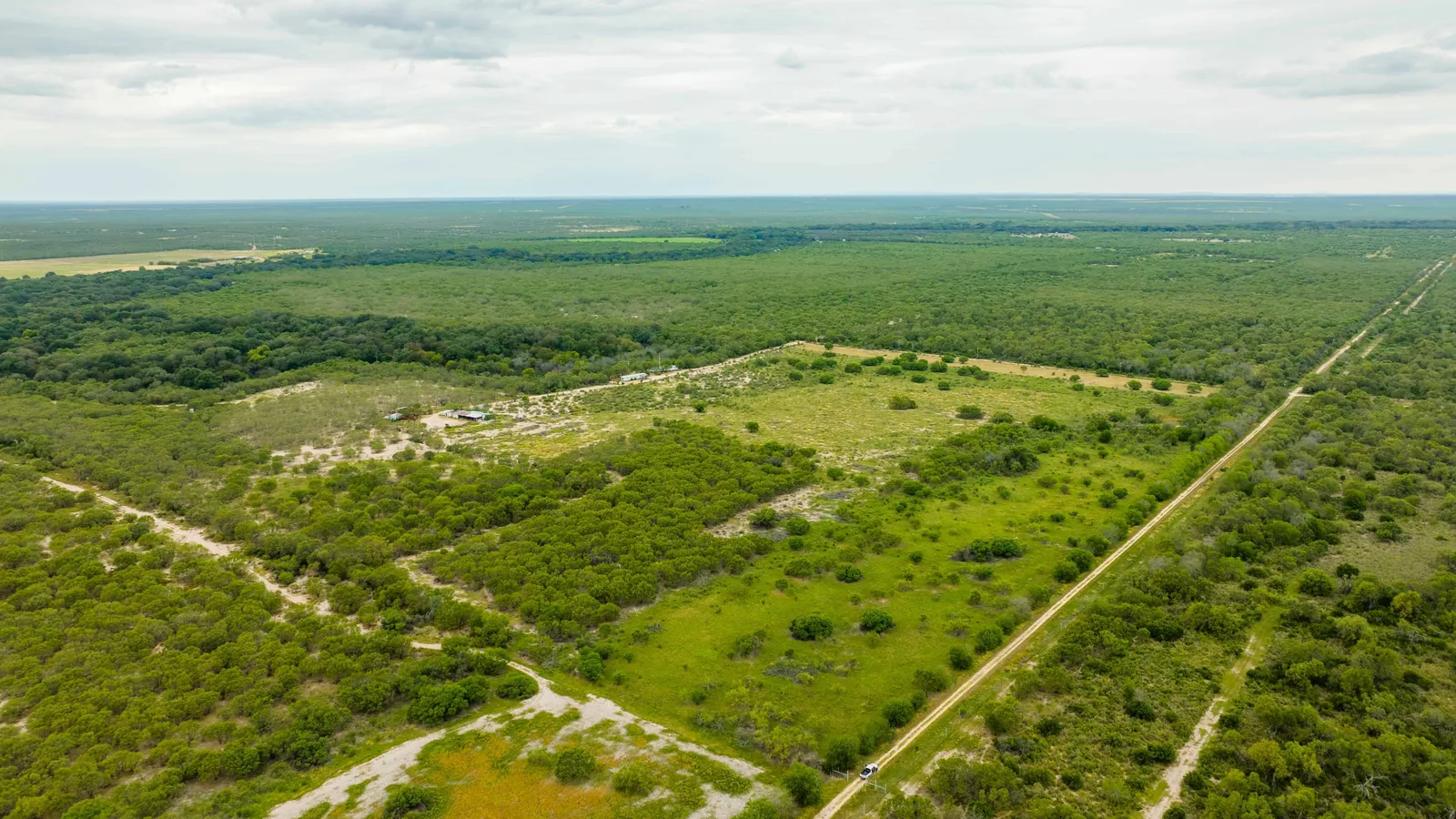
TPWD’s map of wildlife appraisal regions puts Webb County in the South Texas Plains. A few counties toward the coast fall in other regions, so check the map for yours.
The Comptroller’s guidelines describe brush management as “selectively removing or suppressing targeted woody species” so better plants can grow. It also means keeping “the proper kind, amount and distribution of woody cover” for the animals you manage.
TPWD’s South Texas guide gets specific. Any clearing should leave clumps or strips of brush you cannot see through in winter. Cover strips should run as unbroken as possible, so wildlife have travel lanes. A small ranch needs more cover, by percentage, than a large one.
The same guide sets a floor. Brush management should touch at least 10 percent of the plan’s area each year, or 10 acres, whichever is smaller. TPWD’s plan form asks how many acres get treated, by what method and in what design: block, mosaic or strips.
When mesquite and prickly pear take over, TPWD says plant variety and habitat quality drop. Mesquite sprouts from buds on a buried crown. TPWD lists root plowing among the methods that work on mature mesquite, given the right soil moisture.
Work that only takes the top growth can lead to more sprouting. Our guide on why mesquite comes back after clearing covers regrowth in more detail.
What does the appraisal district ask for?
To switch, you file a new Application for 1-d-1 (Open-Space) Agricultural Use Appraisal and a wildlife plan. The plan goes on TPWD’s form, PWD 885-W7000. The Comptroller’s guidelines say both are due before May 1, postmarked by April 30.
The form says to submit the plan to your county chief appraiser, not to TPWD. TPWD’s FAQ adds that the law does not require TPWD to approve your plan. The appraisal district decides. For land in Webb County, that is the Webb County Appraisal District.
You can write your own plan on the TPWD form. The Comptroller lists help from TPWD and Texas A and M AgriLife Extension. The Natural Resources Conservation Service (NRCS) and other qualified wildlife biologists can help too.
A district may also ask for a yearly report on TPWD’s annual report form, PWD 888. The Comptroller says no penalty or late fee applies if that report comes in late. TPWD’s South Texas guide suggests keeping receipts and photos of the work. A map of the treated acres helps too.
Most tracts face no minimum size. A minimum applies when a tract has shrunk since January 1 of the prior tax year. In the South Texas Plains, the chief appraiser picks it from a standard range of 25 to 50 acres.
How does NRCS EQIP cost share fit in?
EQIP, the Environmental Quality Incentives Program, is a voluntary federal program run by NRCS. It pays part of the cost when ranchers put conservation practices on the ground. TPWD’s Farm Bill page lists brush control among the common EQIP practices.
The same page says practice payments typically run 50 to 70 percent of the estimated total cost. Beginning, limited resource or socially disadvantaged ranchers can get up to 50 percent in advance. Applications are taken year-round at local USDA Service Centers and conservation district offices.
An EQIP contract and a wildlife plan are separate paperwork with separate offices. Talk to NRCS before the brush work starts, so the contract and the work line up.
Where does a skid steer with a mulching head fit?
Our part is the machine work under habitat control. The mulching head grinds the brush the plan marks, and the mulch stays on the ground as cover. Mottes and cover strips you mark stay standing. Where the plan calls for it, the rippers root plow the lanes to slow regrowth.
A strip design leaves open lanes between the cover, the same shape as a sendero. Our sendero clearing work cuts and keeps those lanes, and brush clearing opens pasture outside the plan. The appraisal district still decides what counts toward your plan.
A biologist and your plan set the acres and the pattern. You or your agent file with the appraisal district. We look at the land or your photos and put the quote in writing. See how our wildlife exemption brush management works, or call or text (956) 206-3992.